
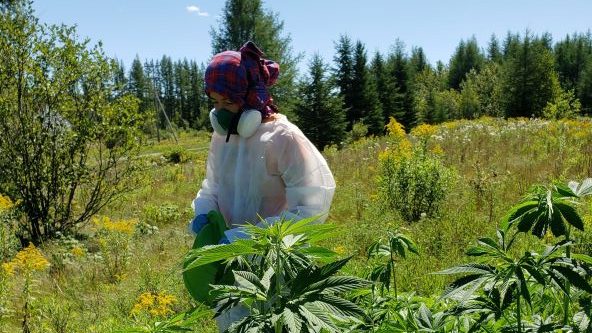
Does FIBER hemp remove PFAS from the soil?
Yes. Hemp removes PFAS and stores it throughout itself – in the leaves, seeds, stalks, roots, and flowers. We harvest right when the hemp starts to go to flower to prevent PFAS from accumulating in the pollen and blowing around.
WHAT DO YOU DO WITH THE HEMP AFTER THAT? YOU CAN’T JUST PUT IT IN A LANDFILL, RIGHT?
We agree that putting PFAS-filled hemp in a landfill and making it someone else’s problem is not the solution. Right now, we are collaborating with scientists who are testing methods to break down the PFAS in the hemp – to get rid of it altogether. We are currently only growing enough hemp to send to the scientists. Once the breakdown of the PFAS is figured out, we will grow at large scales to remove as much of these toxins from the land as we can and get rid of them.
What is phytoremediation?
Phytoremediation is a process of growing certain plants to remove contaminants from the soil, water, or air.
IS hemp GOOD AT phytoremediation?
Yes, fiber hemp is excellent at removing many contaminants from the environment. Its deep root system, quick growth, high biomass, and hyperaccumulation properties allow hemp to remove toxins quickly. Hemp was banned for several generations, and during that time we were not able to grow it to clean the environment or study its ability to remove various contaminants.
What ARE People From the Mi’kMAQ nation saYING about it?
Richard Silliboy, vice chief of the Mi’kmaq Nation said:
“Having the earth as clean as possible is the job of all Native Americans. It is our job to take care of Mother Earth, and it is a very difficult job for all the tribes to do this because there is so much contamination that’s being put into the ground. The ground is being abused in many ways by companies that dump waste all over the place. It’s very concerning to tribes across the country, and it’s up to Native Americans to take care of Mother Earth. That is our goal and always has been and always will be.”
Chief PeterPaul said:
“Protecting the land is part of the Mi’kmaq beliefs. Anything we can do to contribute to making the environment better we want to be a part of. That’s what sustainability is. If you don’t have anything to sustain, we’re going to be in trouble, so we need to make every effort to practice it. We want to be sovereign, and keeping our sovereignty means protecting the earth. Everything from the air quality to the water quality is impacted by the soil, so any help we can bring we want to do that.”
WILL YOU BE PUBLISHING MORE RESEARCH PAPERS SOON?
Yes, we will continue to publish more research! We published 4 collaborative research papers in the first 5 years of work!
 Upland Grassroots